A five-point guide to getting your tweets retweeted

(Image: Dan Kitwood/Getty)
What makes one tweet get passed on, and not another?
On Twitter, your followers can repeat your messages to their own followers. Getting such retweets is a way to increase your profile and network size, and it's arguably part of the reason why many users keep coming back: that little dopamine squirt you get when you discover somebody has liked your wittering can be addictive.
Retweeting is also one of the main ways that information spreads across the social network, so researchers, companies and governments want to know how it works. Previous research has shown that if your message is retweeted it will reach, on average, 1000 people, no matter how many followers you have.
International Conference on Web Science 2011 in Koblenz, Germany.In general, tweets containing URLs, usernames, and hashtags - usually used to denote topics - were more likely to be retweeted than those without such paraphernalia. But not in isolation - other factors matter. Naveed and colleagues identified five such rules to increase your chances of a retweet:
1) Watch your punctuation
Tweets with exclamation marks were unlikely to be retweeted. The opposite was true of question marks. The researchers speculate that in some cases this could be because tweets that pose questions are passed on to provide or find an answer.2) Nice words trump nasty
Tweets containing strong positive words like "great" or "excellent" and negative terms such as "suck" or fail" were likely to be retweeted. But positive terms were slightly more so. The researchers suggest that this might be because people could be a bit more reluctant to retweet rude or harsh terms.3) Use emoticons wisely
Conversely, including a positive emoticon, such as :-), is a sure way to lower your probability of a retweet. A negative one, such as :-( increases the chances.4) Be relevant
The team identified more than 100 different topics that people tweeted about. Not surprisingly, those that addressed broader public interest were more likely to be retweeted than, for example, messages about how users felt that day, or messages directed specifically at another person (@replies). The most popular retweeted topics in the dataset concerned social networking, public holidays and the economy. The researchers reckon this suggests Twitter is better suited as a service for channelling news than for personal communication.5) Bad news is good
The researchers studied the sentiments expressed in their dataset of tweets, by looking for words that are known to correspond to certain feelings. These were given a numerical value on various scales that range from, for example, pleasure to displeasure, or excitement to calmness. They found that tweets which were annoying or not pleasant tend to get retweeted often. Likewise for tweets that expressed exciting or intense sentiments. In other words, they say, bad news travels fast on Twitter.
June 29, 2011
NEW SCIENTIST! Five-point Retweet GUIDE
impartial drugs advice
Sacked scientist promises impartial drugs advice
Andy Coghlan, reporterThe scientist sacked by the British government for allegedly criticising government drugs policy today made good on his promise to set up his own committee to investigate and publicise the science of recreational drugs.
"We will provide the truth about drugs unfettered by any political interference," said David Nutt of Imperial College London, and the former head of the government's asked to leave last October by Home Office minister, Alan Johnson.
Now, true to his promise, Nutt is chairman of his newly created Independent Scientific Committee on Drugs, and today proudly announced that its first meeting took place yesterday.
So far it has 14 members, including four of the five who resigned from the ACMD last October in protest at the sacking of Nutt. "This is the strongest grouping of scientists we've ever had in this country [who are experts on recreational drugs]," said Nutt. "The best science will come from us."
Already, the new committee has decided on its first three programmes.
The first will investigate the dangers of "not outlawed but which may be causing serious harm to users who buy them freely on the internet.
They include substances such as mephadrone, described by committee member Les King, an adviser to the government on new psychoactive substances, as a cross between amphetamines, Ecstasy and cocaine. ">not outlawed but which may be causing serious harm to users who buy them freely on the internet.
They include substances such as mephadrone, described by committee member Les King, an adviser to the government on new psychoactive substances, as a cross between amphetamines, Ecstasy and cocaine. "People assume they're safe, but we don't know," says King.
Next up will be a re-assessment of the relative harms of different recreational drugs, both legal and illegal.
Nutt is particularly keen to highlight what he describes as ">legal and illegal.
Nutt is particularly keen to highlight what he describes as "aberrations" in the current UK government classification of certain drugs, with relatively safe ones such as alcohol not classified at all.
"At some point, we will put together an assessment of drug harms which will challenge some of the aberrations," says Nutt.
The third project will focus on ketamine, also known as "special K", a drug that is rising in recreational usage. Val Curran of University College London, who will head the study, says that ketamine is already "showing a clear profile of addiction".
In heavy users, it is also causing such serious bladder damage that some have had to have their bladders surgically removed. Two users died drowning in the bath, she says.
The birth of the new committee does raise some interesting questions. First: can it be trusted to be truly impartial? Does it represent a true consensus, and where does it get its funding from?
Equally, where does it leave the ACMD? Some founder members of the new committee are also on the ACMD.
Nutt did turn slightly prickly when asked by a reporter whether his committee would admit ">are also on the ACMD.
Nutt did turn slightly prickly when asked by a reporter whether his committee would admit "dissident" scientists whose views clash with those prevailing among the founder members. Some scientists, for example, say there's evidence that Ecstasy and cannabis are more dangerous than portrayed by Nutt and other scientists.
In response, Nutt said that, "if the science is good enough, there should be no reason why people shouldn't join us".
And who is funding it all? Not the head of a Colombian drugs cartel, we hope. It turns out to be a wealthy benefactor, Toby Jackson, who is a hedge-fund manager.
"He wants policy driven by scientific evidence," says Nutt. Nutt says that funding is assured for at least three years, costing around £150,000 per year, but the hope is that other sources of funding and public donations will swell the kitty and consolidate the committee.
Another possible source of money could be projects commissioned by the government.
And where does it leave the ACMD? Nutt says that the new chairman, Les Iversen of the University of Oxford, has already sent Nutt his best wishes for the new committee, expressing the hope they can "work together".
But the arrival of the new committee is clearly and deliberately a middle-finger salute to a government seen by Nutt and others as unwilling to grant true independence to its scientific advisers.
thaumatrope
Animation Muybridge
Animation Basics
Animation on the Web incorporates many technologies with the goal of creating on-screen movement. Motion captures attention. It is, in a very real sense, moving. Like the earliest animation technologies, such as Zoetropes and other innovations of the 19th Century, animation relies on the eye's persistence of vision.
The term persistence of vision refers to the fact that light's stimulus lingers on the retina slightly longer than it actually shines on the eye.

BC 6fps BC 12fps BC 24fps BC 30fps BC60fps
Movies, short for moving pictures, have been around for more than a century. Movies work because of persistence of vision, the fact that a human eye retains an image for about one-twentieth of a second after seeing it.
Beta movement
Beta movement is a perceptual illusion, described by Max Wertheimer in his 1912 Experimental Studies on the Seeing of Motion, whereby two or more still images are combined by the brain into surmised motion. This is often erroneously referred to as the phi phenomenon, which is a different, related illusion.
The classic beta phenomenon experiment involves a viewer or audience watching a screen, upon which the experimenter projects two images in succession. The first image depicts a ball on the left side of the frame. The second image depicts a ball on the right side of the frame. The images may be shown quickly, in rapid succession, or each frame may be given several seconds of viewing time. Once both images have been projected, the experimenter asks the viewer or audience to describe what they saw.
Generally, audiences will claim that they saw a ball move from left to right. They did not, in fact, see this, but the cognitive process of perception links the two images in time and causality.
The Zoetrope
In the early 19th century, several devices began to appear that used persistence of vision to create the illusion of motion from still images. The zoetrope, invented by William George Horner in 1834, consisted of a series of pictures on a paper strip arranged on the inside of a revolving drum. The drum had small slits you could look through to see the pictures.


Most 19th century zoetropes had thirteen slots. A strip with 12 images will produce a moving subject that appears to progress forwards. A strip of 13 images (the same number as slots) gives a moving image that is stationary. As the figures are always moving when viewed, they appear rather fuzzy.

Muybridge
To settle a wager regarding the position of a trotting horse's legs (based on Marey's work), Eadweard Muybridge, a British photographer who had recently been acclaimed for his photographs of Yosemite.
Although Muybridge initially considered the task impossible, he made history when he arranged 12 cameras alongside a race track. Each was fitted with a shutter working at a speed he claimed to be "less than the two-thousandth part of a second." Strings attached to electric switches were stretched across the track; the horse, rushing past, breasted the strings and broke them, one after the other; the shutters were released by an electromagnetic control, and a series of negatives made. Though the photographs were hardly more than silhouettes, they clearly showed that the feet of the horse were all off the ground at one phase of the gallop. Moreover, to the surprise of the world, the feet were bunched together under the belly. None of the horses photographed showed the "hobbyhorse attitude" - front legs stretched forward and hind legs backward -so traditional in painting. The photos were widely published in America and Europe. The Scientific American printed eighteen drawings from Muybridge's photographs on the first page of its October 19, 1878 issue.

Readers were invited to paste the pictures on strips and to view them in the zoetrope.
In 1880, using a similar technique with a device he named the zoogyroscope, or zoopraxiscope, Muybridge projected his pictures on a screen at the California School of Fine Arts, San Francisco." Motion pictures were born...


Eadweard Muybridge's 'Zoopraxiscope' Projector, c.1885
The Zoopraxiscope projected a series of images ( hand painted from Muybridge's photographic sequences ) on a circular rotating glass plate. The images were elongated to compensate for the distortion caused by projection through a rotating shutter


The Kineograph
The Kineograph was invented/devised by John Barnes Linnett (British Patent 925. Filed March 18. Issued September 5, 1868).
It is also known as a flipbook, and consists of drawings or photographs in sequential stages of movement bound as a book. To view, the book is flipped through rapidly with the thumb. These are simple but effective, and were the first devices to present animation in a linear, rather than circular, sequence.
The Kineograph is simple but rewarding to construct. Start with a small blank tablet of fairly stiff paper. On each page, draw one image. The movement of each drawing should lead into the next. Keep in mind that the images will move by at a rate of many per second, so the movements should be gradual. Once you are happy with your drawings, rapidly flip through the pages. The little drawings should spring to life.

http://www.fliptomania.com/
The Mutoscope
The Mutoscope is based on the same principle, but the images are drawn on individual cards and are flipped mechanically. This can be reproduced fairly simply, but the sequence won't be as long. Shown in the drawing is a basic layout. The images are on small, tabbed cards stuck evenly around a cork. The cork is impaled on to a thin bent metal rod that serves as a crank. The whole thing is set in a box with a small window cut into it and a protruding tab to catch the images, causing the "flip" action. The box should be just large and deep enough to accommodate the images.


Quicker Than the Eye
All cinematic animation, film, and video is made up of many individual frames that leave their unmoving ghosts frozen in the eye until the next image flashes before it, until the brain is tricked into thinking that it is seeing one thing moving, instead of many things standing still. If our eyes were quicker and our brains not so gullible, we'd see movies and cartoons as an endless procession of monotonous freeze frames, with characters chronicled in every imaginable pose like an obsessive-compulsive comic book that never gets to the point.
In some ways, the Web is even more demanding on the eye's and brain's imaginative trickery. Movies and video reliably deliver 24 and 30 frames per second, respectively, to our eye-brains, which are completely adequate for tricking us into believing that we're seeing unbroken motion. Even as few as 15 frames per second can be enough to eliminate the impression of strobing or flicker, which is what you get when you turn a strobe light down to low speeds.
Suffice to say that more frames per second are better, up to the point where more frames means more work without resulting in better motion. Games are now toying with 60fps.........
Key Frames
If frames are the building blocks of all animations, then key frames are the cornerstones. Picture Elmer Fudd pointing a shotgun at Bugs Bunny's nose; then picture Bugs placing a carrot in the muzzle of the shotgun. Defining the scene takes only two frames; the rest is just in-between filler. In all animation, defining the key frames is the art, and inbetweening is the chore—often left to assistants or, in computer-generated graphics, to the animation software.
In traditional cel animation, the key frames usually define poses or moments in the action that divide one action from the next, such as a boxer coiling, swinging and missing, twirling in a tornado of household objects, and then crumpling to the ground. Teams of artists might be employed to do the tweening between these key frames, drawing, inking, painting and photographing the 24 individual cells that make up every second of a film.
In some animation programs, key frames define the state of objects at critical points in time, and the computer is relied on to tween the motion between the frames, calculating the countless changes at every intervening frame. Imagine drawing the explosion of the White House in the movie Independence Day by hand—millions of fragments of debris, dust, and smoke, to be drawn one frame at a time. There's a good reason why this type of realistic animation didn't exist until the advent of powerful computers running equally impressive software. In complex 3-D animation, animators have only to define the key frames and let the computers do the rest. This is not to imply that defining the key frames in a 3-D system (or a 2-D program such as After Effects) is easy—in any form of art, what's easy is rarely worth doing. But these systems eliminate much of the drudgery of old-school cel animation.
The very-low-bandwidth banner ads that are currently in vogue on the Web are made up of almost nothing but key frames with all in-between motion omitted. This is the shortest way to tell a story, but it's only a skeleton. Today's banner ads are an acknowledgment of the bandwidth limitations of the majority of Internet connections, not a stylistic choice. In the future, you'll see animated ads and every other type of animation with all the in-between frames where they belong.


Muybridge Horse


June 28, 2011
Google Goth and Black Bars
Evolving the Google design and experience
Starting today, you might begin noticing that things look a little different across Google products. We’re working on a project to bring you a new and improved Google experience, and over the next few months, you’ll continue to see more updates to our look and feel. Even our classic homepage is getting a bit of a makeover:
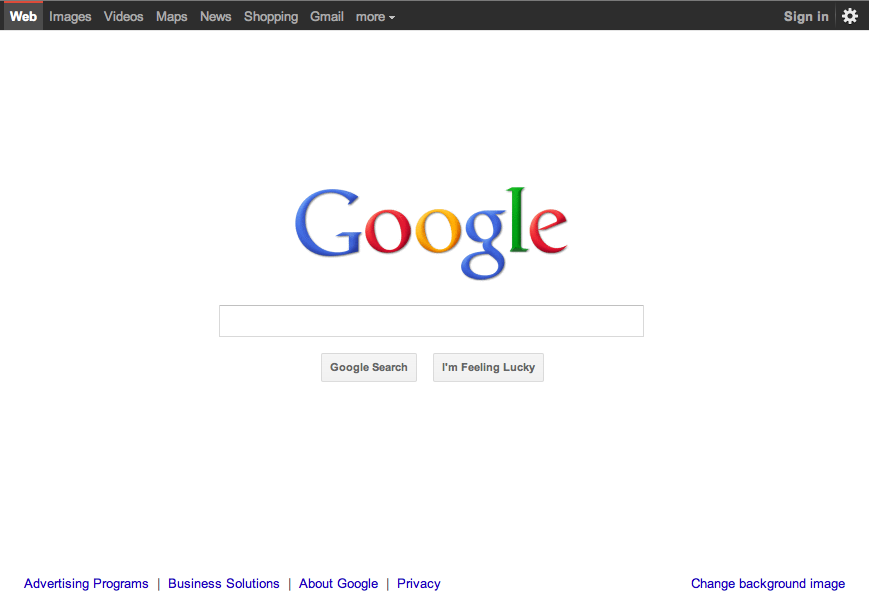
The way people use and experience the web is evolving, and our goal is to give you a more seamless and consistent online experience—one that works no matter which Google product you’re using or what device you’re using it on. The new Google experience that we’ve begun working toward is founded on three key design principles: focus, elasticity and effortlessness.
- Focus: Whether you’re searching, emailing or looking for a map, the only thing you should be concerned about is getting what you want. Our job is to provide the tools and features that will get you there quickly and easily. With the design changes in the coming weeks and months, we’re bringing forward the stuff that matters to you and getting all the other clutter out of your way. Even simple changes, like using bolder colors for actionable buttons or hiding navigation buttons until they’re actually needed, can help you better focus on only what you need at the moment.
- Elasticity: In the early days, there was pretty much just one way to use Google: on a desktop computer with an average-sized monitor. Over a decade later, all it takes is a look around one’s home or office at the various mobile devices, tablets, high-resolution monitors and TVs to see a plethora of ways to access the web. The new design will soon allow you to seamlessly transition from one device to another and have a consistent visual experience. We aim to bring you this flexibility without sacrificing style or usefulness.
- Effortlessness: Our design philosophy is to combine power with simplicity. We want to keep our look simple and clean, but behind the seemingly simple design, use new technologies like HTML5, WebGL and the latest, fastest browsers to make sure you have all the power of the web behind you.
Constant revision and improvement is part of our overarching philosophy. For example, last year we introduced an updated look and feel to our search results, and if you compare the original Google homepage to today’s version, you’ll see that a makeover every so often can certainly be refreshing:

Starting today and over the course of the next few months, look for a series of design improvements across all our products, including Google Search, Google Maps and Gmail.